Before the First Line Is Spoken: How Production Design Becomes the True Director of Audience Attention
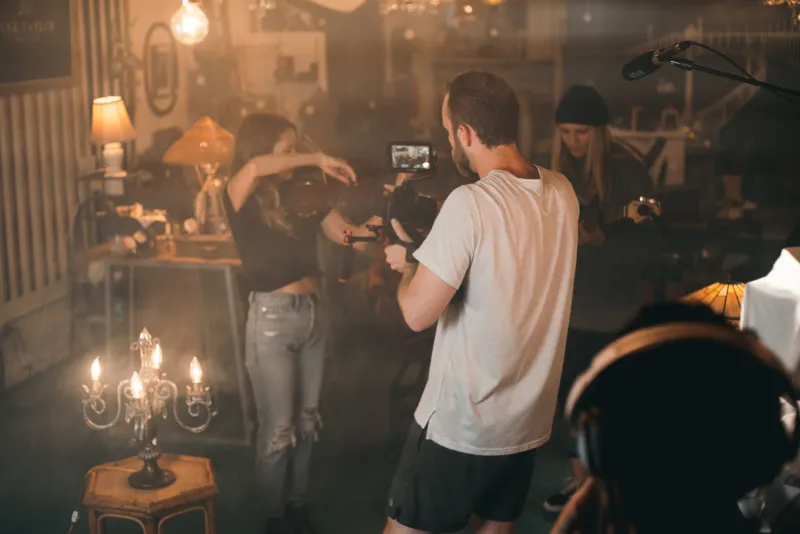
Long before an actor delivers a single line, the environment surrounding them has already begun shaping what an audience feels, where they look, and what they believe. Production design functions as a silent but authoritative visual language — one that operates beneath conscious awareness yet governs nearly every emotional response a viewer experiences. Understanding this discipline is not optional for serious visual creators; it is foundational.
The Set as a Sentence
Most discussions of visual storytelling center on camera movement, lighting ratios, or editorial rhythm. These are legitimate concerns. But the conversation rarely begins where the story itself begins: with the physical world the characters inhabit before they ever open their mouths.
A production designer is, in the most precise sense, an architect of perception. Every object placed within the frame, every surface treatment applied to a wall, every deliberate absence of furniture in a room — these choices constitute a form of pre-verbal communication directed at the viewer. The audience reads the environment before they read the character. They form judgments about power, vulnerability, warmth, and threat based entirely on spatial cues that were engineered weeks or months before principal photography began.
Consider the distinction between a cluttered, low-ceilinged apartment dressed with mismatched furniture and faded personal photographs versus a sparse, high-ceilinged interior with cold stone surfaces and minimal ornamentation. Neither requires dialogue to communicate character or circumstance. The environment has already done the work.
Spatial Hierarchy and the Direction of the Eye
One of the most underappreciated functions of production design is its role in controlling sightlines — both within the story world and from the viewer's perspective beyond the screen.
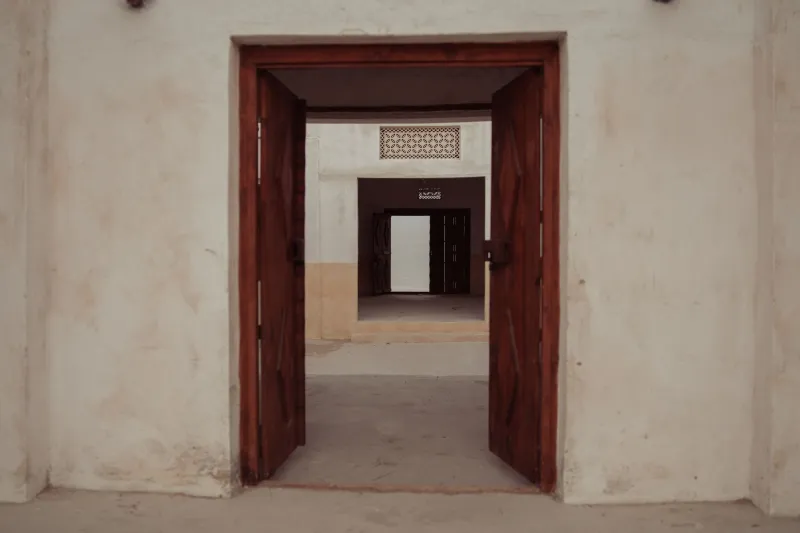
When a production designer positions a brightly lit doorway at the far end of a long corridor, they are not simply decorating a hallway. They are constructing a visual vector that draws the eye forward and implants a sense of anticipation or dread depending on what accompanies that composition. The depth of the space, the convergence of parallel lines, the placement of props along the path — each element compounds the directional pull.
This principle was applied with particular discipline in No Country for Old Men (2007), where the Coen Brothers and production designer Jess Gonchor used the stripped, weathered interiors of West Texas motels and rural gas stations not merely as authentic period dressing but as spatial environments that communicated moral vacancy. The rooms felt depleted of safety. Viewers understood this before a single act of violence occurred because the design had already evacuated warmth from the space.
On the independent side, Chloe Zhao's work on Nomadland (2020) demonstrates how production design can operate through restraint rather than construction. The deliberate integration of real locations — actual RV communities, functional diners, working Amazon warehouses — created an environmental authenticity that no fabricated set could have replicated. The design strategy was one of curation and preservation rather than invention, yet it exercised the same directorial authority over viewer attention and emotional alignment.
Color as Spatial Architecture
The color palette of a production environment is not a decorative afterthought. It is a structural decision with measurable consequences for how audiences process narrative information.
Color temperature and saturation levels within a set can establish temporal period, psychological state, and social strata simultaneously. Warm, desaturated tones in earth ranges frequently signal economic constraint or emotional exhaustion. High-contrast, deeply saturated environments tend to communicate artifice, excess, or instability. These associations are partly cultural and partly neurological — the human visual system responds to chromatic information before the conscious mind assigns meaning to it.
Wes Anderson's productions represent perhaps the most deliberate application of this principle in contemporary American cinema. The production design across films such as The Grand Budapest Hotel (2014) uses color not merely to create visual signature but to demarcate emotional registers. The transition between time periods in that film is communicated largely through shifts in aspect ratio and palette — moves that require the viewer to recalibrate their emotional posture without a single line of expository dialogue.
For independent filmmakers and visual creators working with constrained budgets, this principle carries significant practical value. Color correction during post-production is a powerful tool, but it operates on what already exists within the frame. Thoughtful decisions made at the design stage — choosing a paint color for a key location, selecting furniture with deliberate chromatic relationships, controlling the color temperature of practical light sources — can achieve narrative results that no amount of grading will replicate if the foundation was not laid during production.
Objects as Narrative Anchors
Beyond spatial arrangement and color, individual objects within a production environment carry substantial narrative weight when deployed with intention.
The concept of the meaningful prop is well understood in screenwriting circles, but production designers engage with it from a different vantage point. Where a writer might use a recurring object as a symbolic motif across scenes, a production designer considers how that object sits within its spatial context — how it is lit, what surrounds it, whether it occupies a position of visual prominence or is partially obscured.
In Parasite (2019), production designer Lee Ha-jun constructed the Park family home as a physical expression of social aspiration and its limits. The semi-basement apartment of the Kim family was built on a studio lot to precise specifications — low ceilings, narrow windows positioned near ground level, the pervasive presence of the street above. These were not incidental features. They were engineered conditions that placed the audience in a state of environmental claustrophobia that dialogue alone could not have produced.
The stone at the center of that film — a seemingly mundane object presented as a gift — acquires its narrative power partly because of how it is framed within the production environment. Its presence is made legible through design before the script assigns it explicit meaning.
The Practical Argument for Designers in Every Production
For American independent filmmakers operating outside the studio system, the temptation to treat production design as a secondary concern — something addressed after casting, location scouting, and cinematography — is understandable but costly.
Environmental storytelling is not a technique reserved for large-budget productions with dedicated art departments. It is a discipline of attention that applies equally to a short film shot over a weekend and a prestige drama developed over years. The question is not whether a production has the resources to hire a production designer. The question is whether the people making decisions about the physical world of the film understand that those decisions are, in fact, narrative decisions.
A filmmaker who approaches every set — however modest — with the question of what the space is communicating before anyone speaks will consistently produce more coherent and emotionally resonant work than one who treats the environment as neutral backdrop.
Design as the First Draft of Story
The most sophisticated visual creators understand that the environment is not where the story takes place. The environment is the story, rendered in physical form before performance or dialogue introduces its next layer.
Production design, at its highest level of practice, is the discipline of making a space do the work of a paragraph — directing attention, establishing emotional register, and encoding meaning into surfaces, distances, and objects that an audience will absorb without realizing they are being guided. That is not a supporting role in the filmmaking process. It is, in many cases, the first and most durable form of direction a production will ever exercise.